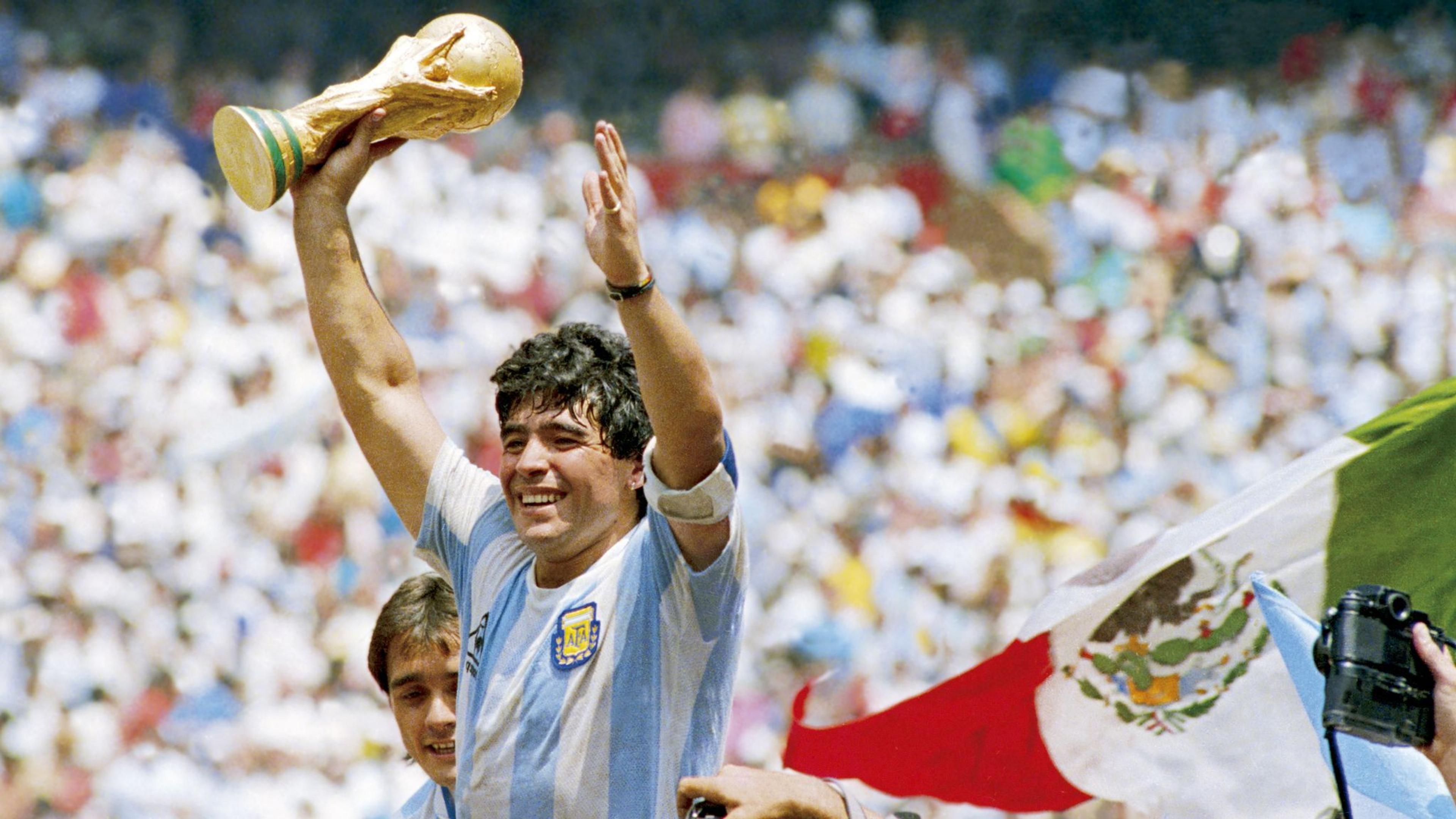
If you love football, or have ever found yourself fascinated by this strange and beautiful game, then no matter which generation you belong to, you should know about Diego Armando Maradona. In fact, I believe every football supporter must know him. Not simply recognise his name, remember the number ten, or identify the famous blue-and-white shirt, but understand why millions of people still speak about him with a mixture of joy, grief, anger, gratitude, and love.
To know Maradona is to understand why football became much more than twenty-two people chasing a ball. He made it feel like art, rebellion, politics, religion, and theatre unfolding on the same patch of grass. He could make an entire stadium hold its breath with one touch, make a forgotten city feel like the centre of the world, and make people who had very little believe that someone who came from where they came from could stand above everyone. Other great players have dominated football. Maradona seemed to contain football in its entirety.
I did not experience Mexico 1986 as it happened. Like many people from my generation, I inherited Maradona through old recordings, grainy footage, documentaries, stories from older supporters, and arguments that seemed to have no ending. His greatest years had already become history by the time I truly understood the game, yet he never felt historical to me. Every replay still carried danger, as if the outcome might somehow change this time. Every story sounded exaggerated until I watched the pictures and realised that, with Diego, reality had already done the exaggerating.
I am a Milanista, raised on stories of Sacchi, Capello, Maldini, Baresi, Gullit, Rijkaard, and Van Basten. Maradona should have occupied the opposite side of that story, the genius who stood between Milan and glory and carried Napoli into territory previously reserved for the powerful clubs of the north. Yet the more I learned about him, the harder it became to see him merely as a rival. Rivalry can tell us which shirt to defend, but it cannot ask us to deny greatness when greatness becomes this overwhelming.
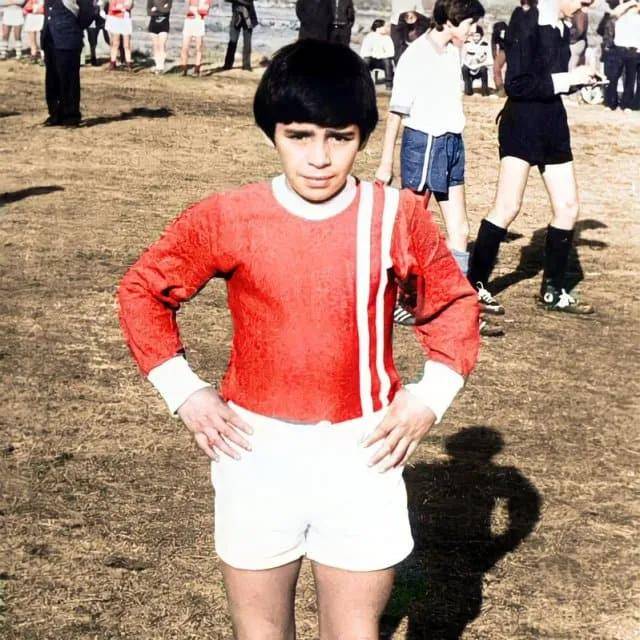
He came from Villa Fiorito, a poor neighbourhood on the outskirts of Buenos Aires, where football was not an extracurricular activity or a carefully designed development programme. It was escape, language, identity, and perhaps the only future a child could imagine clearly. In his first television appearance as a boy, Maradona said that he had two dreams: to play in a World Cup and to become a world champion with Argentina [1]. The sentence sounds almost too perfect when we read it now, but at the time it came from a child who lived in a home without basic comforts and had no logical reason to believe the world would one day know his name.
Perhaps that is why Maradona always played as if the ball belonged to him before it belonged to football. His relationship with it did not look coached. The ball stayed close to his left foot not merely because of technique, but because his entire body seemed organised around protecting an idea. He was short, powerful, and almost impossible to move once he lowered his centre of gravity. Defenders could kick his ankles, lean into his back, or close the space around him, but he somehow kept moving, not in a straight line but through angles that seemed to appear only after he had found them.
What made him extraordinary was not only the dribbling. It was the changing of rhythm inside the dribble, the pause before the acceleration, the small touch that invited a defender closer, and the next touch that made the same defender irrelevant. Maradona could carry the ball like a street footballer, protect it like a fighter, and release it like a playmaker. He saw passes while everyone else was still watching him escape the tackle. His football had imagination, but it also had weight. It was beautiful because it could survive contact.
Mexico 1986 became the tournament in which all of those qualities arrived at once. He finished with five goals and five assists, and FIFA records him as the only player to produce that combination in a single World Cup [2]. Statistics can tell us how much he contributed, but they still struggle to explain the feeling that Argentina's entire tournament was moving according to his imagination. He was captain, creator, scorer, provocation, and emotional centre. When the team needed control, he held the ball. When it needed escape, he dribbled. When it needed a final pass, he saw one. When it needed belief, it looked at him.
I have watched those matches while already knowing every goal, every pass, and every final score, but certainty never removes the tension. Somehow, I still lean closer to the screen when he receives the ball. That may be the simplest measure of his greatness. Decades later, through imperfect footage and without the surprise of seeing it live, Maradona can still make a moment feel undecided. He does not look like a man performing history. He looks like a man inventing it while we watch.
The quarter-final against England gave football the clearest possible portrait of his contradictions. Within four minutes, Maradona scored one goal with his hand and another that would later be voted the Goal of the Century [3]. The first was illegal, mischievous, and permanently controversial. The second was so pure that even the defenders he had beaten could only live inside its memory. One asked us whether genius should be forgiven for breaking the rules. The other made the rules feel too small to contain genius.
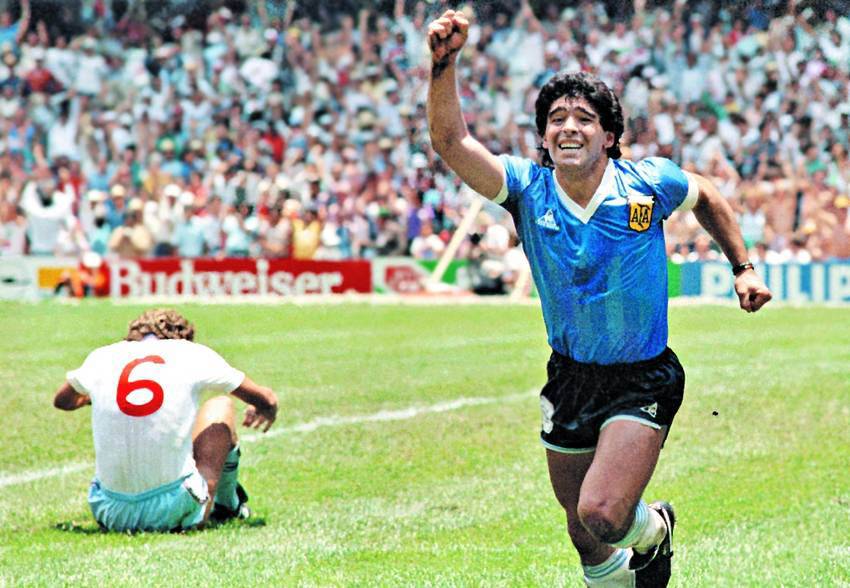
It is tempting to separate those two goals and choose which Maradona we prefer, but perhaps that misses the point. The hand and the run belong together. One was the boy from the street finding a way past a taller goalkeeper; the other was the greatest player in the world moving through an entire defence. Cunning and beauty, survival and art, sin and miracle arrived in the same match, from the same man, wearing the same number ten. No carefully managed sporting biography could have written a more honest introduction to Diego Maradona.
His World Cup was not only that afternoon. He scored twice against Belgium in the semi-final, then created Jorge Burruchaga's winning goal against West Germany in the final when the match had become 2–2 and Argentina's control was slipping away [2]. That last contribution matters because it reveals something that highlight reels sometimes hide. Maradona did not carry Argentina by treating his teammates as supporting actors. At the decisive moment of the final, he carried them by trusting a runner, delaying the pass, and releasing the ball at exactly the right time. The image remembered forever is Diego lifting the trophy, but the tournament was won with his ability to see someone else.
If Mexico made him immortal, Naples made him sacred. When Maradona joined Napoli in 1984, he was not simply moving from Barcelona to another European club. He was moving into a city that understood what it meant to be looked down upon. Italian football's power lived largely in the wealthier north, while Naples carried the stereotypes, resentment, and economic wounds of the south. Maradona arrived with his own memory of poverty and his instinctive sympathy for outsiders. The relationship felt less like a transfer and more like recognition. Naples saw itself in him, and he saw himself in Naples.
Together they disturbed the established order. Napoli won the first Serie A title in the club's history in 1986/87, added the Coppa Italia that season, lifted the UEFA Cup in 1989, and became Italian champion again in 1989/90 [4][5]. Those trophies were sporting achievements, but in Naples they were experienced as something larger. Every victory over Juventus, Milan, or Inter carried the emotion of a city answering the rest of Italy. Maradona did not merely help Napoli win. He gave a marginalised city the most visible man in football and made the centre of the football world move south.
As a Milanista, I know that some of those victories came at the expense of the club I love. Still, when I see Maradona in that Napoli shirt, what I feel is not resentment. I see a footballer taking on wealth, geography, prejudice, and sporting power all at once, then somehow winning. Milan had its great teams, great coaches, and great champions. Napoli had Diego, and for a few extraordinary years, that was enough to make the impossible feel almost inevitable.
This is why his bond with Naples cannot be explained by goals and trophies alone. Great players have brought success to clubs before and since, but very few have become part of a city's private religion. His face appeared on walls, in shops, beside saints, and eventually in the name of the stadium itself. When he died in 2020, people gathered in the streets of Naples as though the city had lost one of its own, even though he had left the club almost three decades earlier [6]. The player had gone. The relationship had never ended.
Even that love contained contradiction. At the 1990 World Cup, Argentina faced Italy in the semi-final at the Stadio San Paolo, Maradona's home ground. Before the match, he reminded Neapolitans that the rest of the country suddenly wanted their loyalty after years of treating their city as less Italian than the north. Many still supported Italy, of course, but he had exposed the tension beneath the occasion. Then Argentina eliminated the host nation on penalties, with Maradona converting one of them [7]. The man Naples loved had broken Italy's heart in Naples. With Diego, devotion was never allowed to remain simple.
Neither was his life. The older I become, the less interested I am in turning real people into saints or villains, and Maradona cannot honestly be understood as either. Any attempt to write about him must resist two easy temptations: reducing him to his scandals, or using his genius to excuse them. His years of addiction damaged his body and his career, while failed drug tests marked the painful decline that followed his greatest years [8]. None of it should be romanticised simply because it belonged to a football icon. Talent is not innocence, suffering is not absolution, and the beauty someone creates does not erase his responsibility for the choices he makes.
But neither should the darkness be used to pretend that the light was not extraordinary. Maradona was not a fictional hero written with a clean moral arc. He was a real human being placed under a level of worship, money, pressure, temptation, and public possession that would deform almost anyone. He made choices for which he remained responsible, but he was also surrounded by people and institutions that benefited from the myth while the man inside it was deteriorating. The world wanted Maradona every day. It was less interested in whether Diego could survive him.
That distinction may be the saddest part of his story. Maradona was the global figure who could command a stadium, confront presidents, provoke entire countries, and make millions feel represented. Diego was still, somewhere beneath it all, the boy from Villa Fiorito who dreamed of playing in the World Cup and winning it for Argentina. One became too large for ordinary life. The other never completely escaped the hunger, insecurity, and need for affection that had shaped him before fame arrived.
Maybe that is also why people loved him with an intensity that statistics cannot explain. Pelé, Messi, Cristiano Ronaldo, and Maradona can be compared through trophies, goals, longevity, and technical qualities, but I am less interested in arranging them on a clean list. Greatness is not always a mathematical question. Maradona represented something different. To the poor, the southern, the ignored, the mocked, and the politically angry, he did not look like excellence produced by a perfect institution. He looked like one of their own breaking into rooms where people like them were not supposed to rule.
Modern football produces stars with carefully protected images, global commercial strategies, controlled interviews, nutrition teams, performance laboratories, and entire organisations designed to minimise uncertainty. Maradona came from another world. He was emotionally exposed, politically loud, frequently wrong, sometimes self-destructive, and impossible to separate from the places and people he carried. He did not behave like a global brand. He behaved like a man who had become larger than every system built around him and was slowly being crushed by the same size.
Perhaps the most moving part of his legacy now sits back where the story began. In 2026, Maradona's childhood home in Villa Fiorito was turned into a community soup kitchen serving hundreds of people in need. A mural on the wall calls it La Casa de Dios, the House of God [9]. There is something almost unbearably fitting about that. The small house that once held a poor boy dreaming of becoming world champion now helps feed other families living with the same inequalities from which he emerged. Long after he played his final match, the place where Diego first dreamed is still giving people something they need to survive.
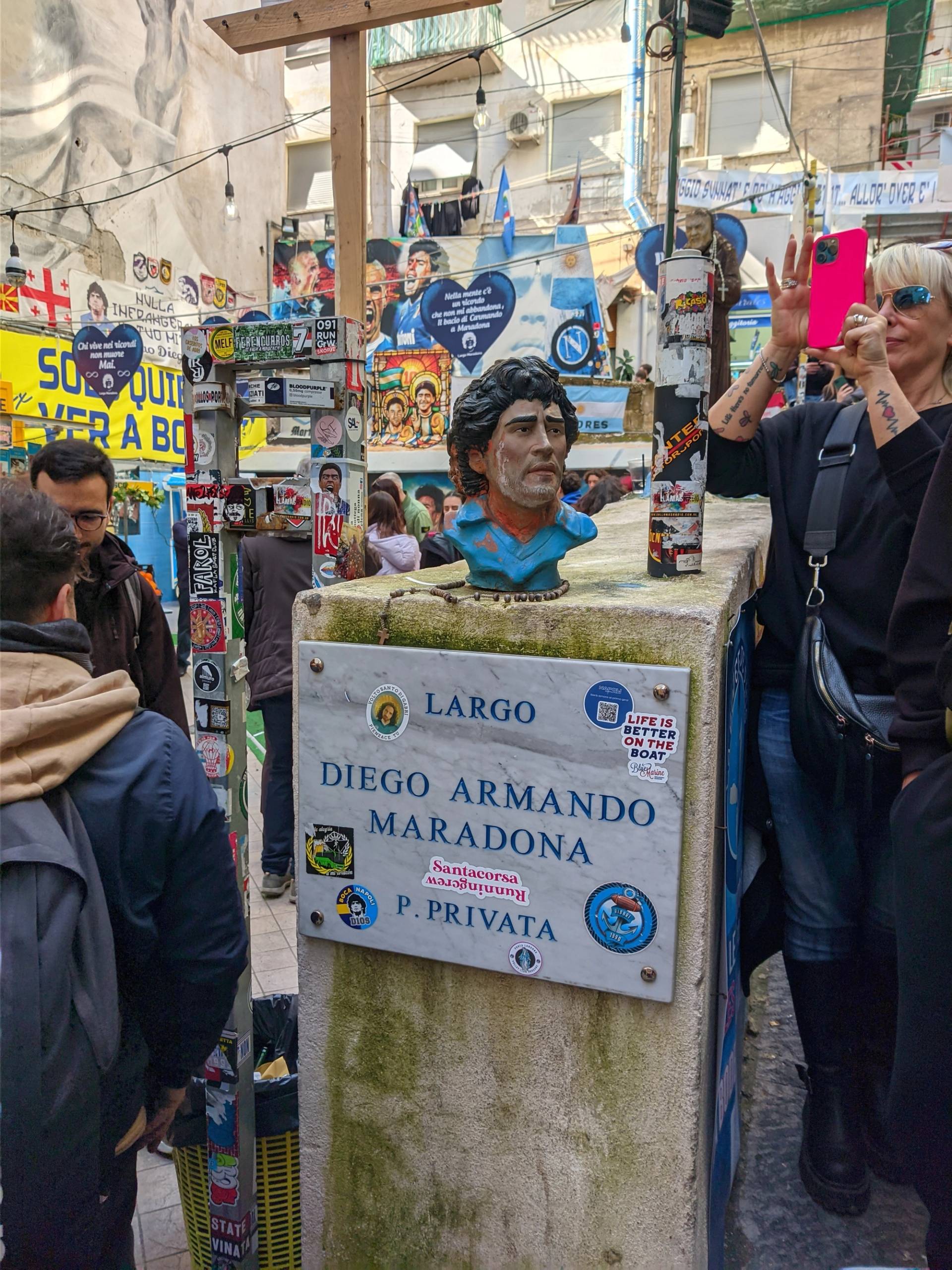
We use the word legend so casually in football that it has almost lost its weight. A player has one great season and becomes a legend. A goal travels around social media and becomes legendary. Maradona reminds me what the word is supposed to mean. A legend is not merely someone whose achievements survive. It is someone whose story grows beyond facts, crosses borders, changes meaning depending on who tells it, and remains alive even for people who never saw him play.
I am one of those people. I never stood inside the Azteca in 1986, never saw him warm up at the San Paolo, and never experienced the fear of watching him receive the ball against the team I supported. Everything came to me later, after the magic had already happened. Yet few footballers I have actually watched live have made me feel as much as Maradona still does through recordings from another era. That is not nostalgia, because these are not even my memories. It is something more powerful: the ability of one man's football to become part of the emotional inheritance of generations that came after him.
Of course, football will always ask us to compare. Pelé had his World Cups. Messi has his numbers, longevity, and almost supernatural consistency. Cristiano Ronaldo turned ambition into an achievement of its own. Every generation will defend the player who first made the game feel miraculous to them, and no spreadsheet can settle an argument built from memory, identity, and love.
But if I must choose, my answer is Maradona. Not because he was flawless, and not because every part of his life deserves defence, but because no other player made football mean so many things at once. In him, the game could be beautiful and brutal, sacred and sinful, joyful and unbearably sad. He could represent a child escaping poverty, a nation recovering its pride, a city confronting the contempt of a country, and a human being slowly disappearing beneath the weight of his own myth.
That is what greatness means to me. It is not only the number of goals scored or trophies lifted, but the size of the feeling left behind. It is the knowledge that somewhere in Buenos Aires, Naples, Jakarta, or a place he never visited, someone can watch that left foot move across an old screen and feel that football has suddenly become larger than it was a few seconds earlier.
Maradona was not football as perfection. He was football as humanity: imagination, defiance, cunning, tenderness, sin, suffering, genius, and poetry held inside the same fragile body. Perfection can be admired from a distance, but Maradona never allows us that comfort. He pulls us into the argument and asks us to love, condemn, forgive, remember, and feel, sometimes all at once.
The game may produce players with better numbers, longer careers, cleaner reputations, and more trophies. I am not sure it will ever produce someone greater, because I am not sure football can again give so much of itself to one human being. When I hold together the boy from Villa Fiorito, the captain at the Azteca, the king of Naples, the fallen idol, and the man whose childhood home now feeds the hungry, only one conclusion feels large enough.
Diego Armando Maradona was the greatest player football has ever known.
/References
[1] Asociación del Fútbol Argentino. Diez frases del Diez que entraron en la historia.https://www.afa.com.ar/4733/posts/diez-frases-del-diez-que-entraron-en-la-historia
[2] FIFA. Diego Maradona tribute: highlights, quotes and stats.https://www.fifa.com/en/tournaments/mens/worldcup/articles/diego-maradona-tribute-highlights
[3] FIFA. Hodge, Maradona and the “Hand of God” shirt.https://inside.fifa.com/news/hodge-maradona-and-the-hand-of-god-shirt-2801683
[4] SSC Napoli. Palmarès.https://sscnapoli.it/en/palmares/
[5] UEFA. 1988/89: Maradona leads the way for Napoli.https://www.uefa.com/uefaeuropaleague/news/00ea-0e6a0cc871e7-6a9bd3c50681-1000--1988-89-maradona-leads-the-way-for-napoli/
[6] Reuters. Naples unites in grief over death of adoptive son Maradona.https://www.reuters.com/sports/naples-unites-grief-over-death-adoptive-son-maradona-2020-11-26/
[7] ESPN. When Naples had “Diego in our hearts, Italy in our songs”.https://www.espn.com/soccer/story/_/id/37424009/diego-maradona-naples-1990-world-cup-italy
[8] Reuters. Soccer world mourns as Argentina great Maradona dies aged 60.https://www.reuters.com/sports/soccer-world-mourns-argentina-great-maradona-dies-aged-60-2020-11-25/
[9] Reuters. Maradona's former home is transformed into a soup kitchen in Argentina.https://www.reuters.com/sports/soccer/maradonas-former-home-is-transformed-into-soup-kitchen-argentina-2026-03-31/
Debriefing (0)
Add to the File