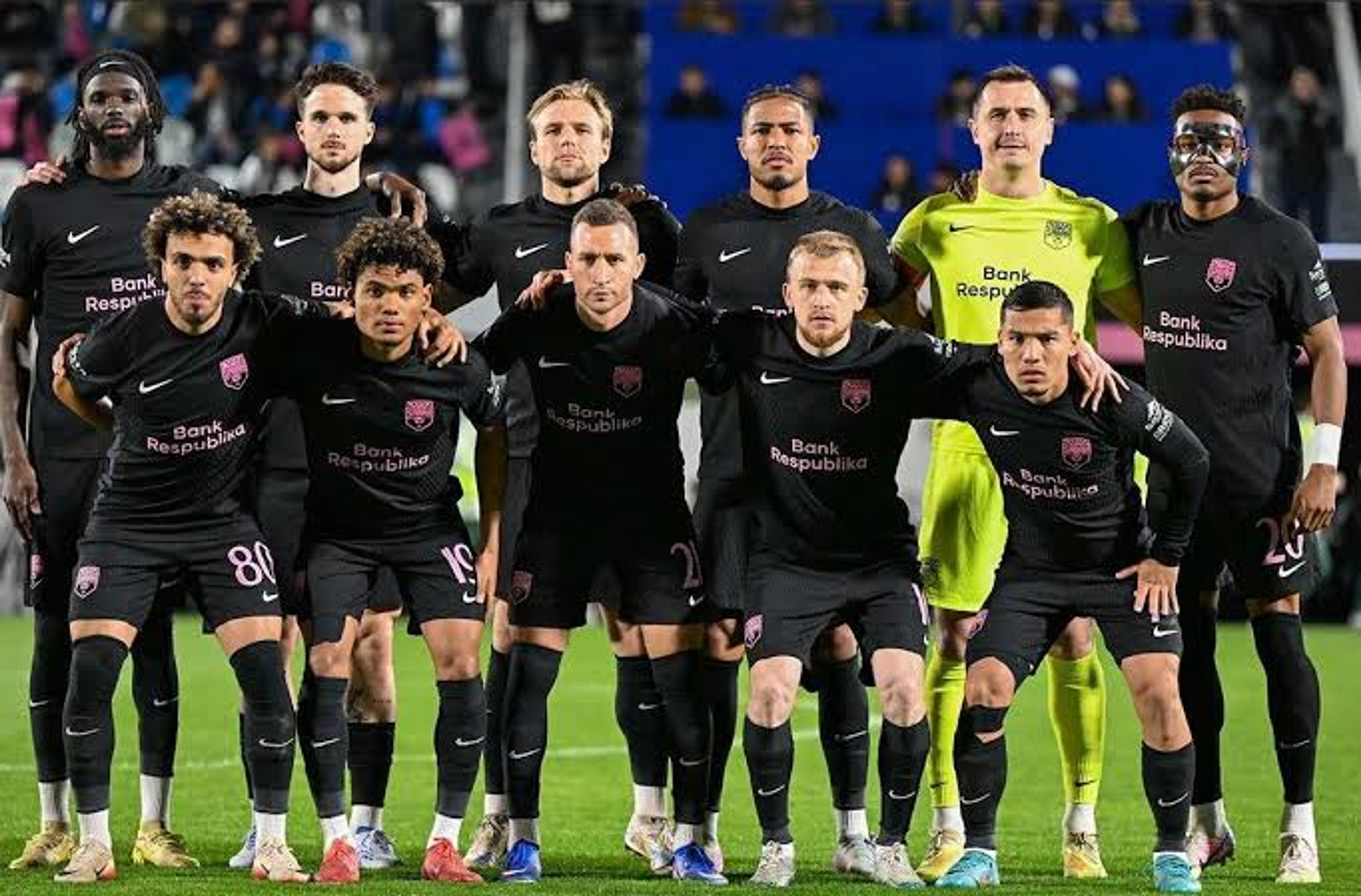
I have to start by congratulating Manchester United. After two seasons away, they are finally back in the Champions League, and there was something familiar about seeing Old Trafford under European lights again. Their opening night went exactly as their supporters would have wanted: four goals, a clean sheet, and a comfortable 4–0 victory. [1]
But while most of the attention naturally went to United, I found myself looking at the other name on the fixture.
Sabah FK.
I had genuinely never heard of them.
At first, I assumed they were simply one of those clubs you occasionally discover through European competition, a champion from a league I rarely follow who somehow survives the qualifying rounds before appearing on the television against one of Europe's giants. Then I looked them up and found one detail that immediately changed the question.
Sabah FK were founded in 2017.
When Manchester United lifted the Europa League trophy in Stockholm in May of that year, Sabah FK did not yet exist. Nine years later, the same club were walking onto the pitch at Old Trafford in the Champions League. UEFA describes Sabah as the youngest club ever to reach the competition's league phase or group stage. [2]
That was enough for me to start digging.
How does a football club go from not existing to the Champions League in nine years?
My first assumption was probably the obvious one. There must be a rich owner behind it. Modern football has given us enough examples of ambitious investors buying clubs, injecting money, recruiting aggressively and accelerating their way up the football pyramid that this almost feels like the default explanation. Sabah's founder, I soon discovered, was Yagub Huseynov, an Azerbaijani entrepreneur whose Bridge Group operates across areas including architecture, construction and real estate. Bridge itself identifies Huseynov as the founder of the group and the owner and chairman associated with Sabah. [3]
So perhaps that was it. A wealthy businessman wanted a football club, funded one properly, and success eventually followed.
Except the more I read, the less that explanation seemed sufficient.
Because before there was Sabah, there was Vətən.
Before Sabah, there was another club name
Sabah's official history dates the club's creation to 8 September 2017. Azerbaijan's published corporate records support that date: Sabah Futbol Klubu LLC was registered on 8 September with initial charter capital of AZN 10,000. [4]
Yet three weeks earlier, on 17 August, Azerbaijani football media were already reporting on a new First Division project called Vətən. Former Neftçi coach Arif Asadov had been appointed to lead it, and he described its central policy as developing promising young Azerbaijani footballers. The same contemporary report stated that the team's expenses would be covered by the Ministry of Education and reported that then-Education Minister Mikayil Jabbarov had given a specific instruction connected to the project. The latter point is contemporary journalism rather than an official Ministry document, so I would treat it as a reported claim rather than definitive evidence of exactly who made the original decision. [5]
Then the chronology becomes particularly interesting. Sabah FC LLC was legally registered on 8 September, but later that month the team preparing for the First Division was still being called Vətən. On 25 September 2017, Qol.az reported that Vətən had officially changed its name to Sabah. [6]
This was the point where my original question began to change. Sabah had clearly been founded as a new legal entity, but its sporting story did not appear to begin from a completely empty page.
That trail led me back to the Vətən Football School.
The problem Sabah was apparently created to solve
Sabah's own academy today states that it was established on the basis of the Vətən Football School. The club says its academy was formally created in 2018 from that existing foundation. [7]
The most revealing explanation, however, comes from Sabah president Maqsud Adigozalov in a long interview published in 2022. His account of the club's creation is far less glamorous than the usual football-owner narrative, but to me it is much more interesting. Adigozalov said that when the people behind Sabah entered football, Vətən was already developing young players. The problem was what happened afterward: some youngsters reached a certain age, could not find a senior team, and effectively saw their football development come to an end. According to him, the decision was therefore made to create a club in the First Division where those players would have somewhere to continue playing. [8]
As someone who works in product development, I found myself looking at this almost like a product problem. The system already had an upstream capability: it could identify and develop young footballers. What it lacked was the next stage of the journey. The academy could produce talent, but without a professional pathway the process was incomplete.
Sabah, according to its president's account, was created to fill that gap.
That does not mean the story should be simplified into “Vətən became Sabah.” Sabah's academy itself says it was later built on Vətən's base, while contemporary reporting says that the First Division side originally carrying the Vətən name was renamed Sabah. Those facts show clear sporting continuity, but they do not by themselves explain every legal, financial or ownership arrangement behind the transition. [6][7]
And this is where Huseynov becomes important again.
The private capital behind the project
Bridge Group explicitly described Yagub Huseynov as Sabah FC's founder when the club announced its Supervisory Board in April 2018. The same announcement said Sabah wanted to build the club on a “healthy foundation” and that the board would help shape development strategy, establish business relationships and attract sponsors and investors. [9]
By July 2018, Report.az also identified Huseynov as Sabah's founder. Contemporary reporting around that period described Bridge Group as the club's principal private financial force, while AFFA also contributed support. [10]
There is an important line I do not want to cross here. I have found reliable evidence that Huseynov is an established entrepreneur, investor and real-estate developer. I have not found reliable evidence that he is a billionaire, despite how easily that word can attach itself to modern football ownership stories. Nor have I found evidence showing that Sabah was created primarily as a real-estate play, a marketing vehicle for Bridge, or a property-development strategy. Huseynov's business background makes those questions reasonable to investigate, but a reasonable hypothesis is still not evidence. [3]
What is documented is that private capital sat alongside unusually visible links to Azerbaijan's public education structure.
The public side is difficult to ignore
Look at Sabah's first Supervisory Board and one name immediately stands out.
Alongside Huseynov were former Azerbaijan international Igor Ponomaryov, businessman Rauf Khalilov, media executive Rahman Hajiyev and Firudin Gurbanov, then Deputy Minister of Education of Azerbaijan. Bridge Group published that composition itself. [9]
That does not make Sabah a state-owned club, and I have found no credible evidence that the Azerbaijani government secretly owned it. But it does make it difficult to portray Sabah's beginnings as an entirely private venture detached from public institutions.
The connection becomes even clearer when looking at AFFA's explanation during Sabah's first promotion process. Sabah finished only fifth in its first season in the First Division. The club nevertheless received a Premier League licence for 2018/19, while eight other applicants were denied one. AFFA's official licensing decision confirms both Sabah's licence and the rejected applications. [11]
That fact alone could easily produce a sensational story: a new club with government-linked figures around it finishes fifth and gets promoted.
But the evidence deserves more patience than that.
Adigozalov later said Sabah had originally planned to spend two or three seasons in the First Division and hoped to earn promotion by finishing first. According to him, the clubs above Sabah were unable to obtain the necessary licences, AFFA offered Sabah the vacant opportunity, and the club accepted it. [8]
AFFA secretary-general Elkhan Mammadov was questioned directly about Sabah in May 2018. He defended the licensing process in institutional terms, arguing that clubs needed proper documents, infrastructure, financial planning and strategic continuity rather than simply sporting results. More significantly, when asked who would financially support Sabah, he said that support could come from the Ministry of Education or another institution and stated that bank guarantees had already been approved from the Ministry's budget. [12]
That is a substantial piece of evidence, but it still needs to be described carefully.
It supports the conclusion that public institutional support was part of Sabah's early environment. It does not, by itself, prove that Sabah was created as a political instrument.
So was Sabah a political project?
This was one of the questions I had when I started researching, especially once government officials began appearing in the story. Mikayil Jabbarov was Azerbaijan's Education Minister from April 2013 until December 2017, meaning his tenure covered both the period in which Vətən's football activities were developing and the months in which Sabah appeared. [13]
But this is exactly where I think football writing has to resist the temptation to make a story more dramatic than the evidence allows.
I can document a Ministry-linked football school. I can document contemporary reporting connecting the Education Ministry to the Vətən First Division project. I can document a Deputy Education Minister sitting on Sabah's Supervisory Board. I can document AFFA's secretary-general referring to Ministry-approved bank guarantees. I can document Huseynov and Bridge Group as Sabah's founder and major private financial backer. [5][9][12]
What I cannot document is a political motive behind the club's creation.
I have found no evidence that Sabah was secretly owned by Jabbarov, created as a government propaganda project, or established to serve some identifiable political objective. Similarly, I have found no evidence that Huseynov's real-estate interests were the hidden purpose of the club.
Maybe further research will uncover something more. For now, the evidence points somewhere more nuanced.
Sabah seems to have emerged from a hybrid institution-building model: an existing youth-development structure supplied part of the sporting foundation; the education system was materially involved around that environment; private capital from Huseynov and Bridge Group helped create and finance a professional organisation; and AFFA supplied the licensing and competition framework within which that organisation could move rapidly into the top division. [7][8][9][12]
To me, that is actually more interesting than discovering another billionaire's football club.
And then I learned what “Sabah” means
There is one part of Adigozalov's interview that stayed with me long after all the governance structures, corporate records and licensing documents.
They could have kept the name Vətən, which means homeland. But according to Adigozalov, football made that awkward. Defeat is unavoidable, and nobody wanted to read headlines effectively saying that “the homeland lost” or “the homeland was destroyed.” So they looked for another name. The young footballers they were developing needed a future, he explained, and they chose Sabah, meaning tomorrow. [8]
It is almost too perfect a football story.
A youth system was developing players but could not always give them a professional future. A club was created to extend that pathway, and they called it Tomorrow.
The romantic in me immediately loves that explanation. The researcher in me also knows that it comes from the club president speaking five years after Sabah's creation, so it should remain what it is: valuable first-hand testimony rather than unquestionable historical truth.
I increasingly think those two instincts are what I enjoy most about researching football. The game gives us stories that invite romance, but the deeper you look, the more complicated they usually become.
Sabah did not exactly come from nowhere
That is probably the biggest thing my original question got wrong.
Sabah FK really is extraordinarily young. Its company was incorporated in September 2017. Its first season was played in the First Division. It reached the Premier League the following year, eventually won Azerbaijan's domestic double in 2025/26, and in 2026 became the youngest club ever to reach the Champions League league phase or group stage. [2][4]
But “founded in 2017” does not necessarily mean “built from nothing in 2017.”
Underneath the nine-year-old club were older institutions, an existing football-development programme and relationships that predated the badge itself. On top of those foundations came private investment, professional management and a structure capable of satisfying requirements that several of its competitors could not.
There are still parts of the story I cannot answer. I have not found a definitive document telling me who first proposed creating the professional club, precisely when Huseynov became involved, what the earliest agreement between Bridge, Vətən and the Education Ministry looked like, or who the original beneficial shareholder of Sabah FC LLC was when it was incorporated. The published corporate record identifies the legal entity, representative, address, capital and registration date, but not the original beneficial ownership. [4]
I would rather leave those questions open than manufacture certainty just to give the article a cleaner ending.
Because maybe the interesting conclusion is already sitting in front of us.
When I first saw Sabah FK beside Manchester United on the Champions League fixture list, I wondered how a football club could possibly go from nothing to Old Trafford in nine years.
After digging into the story, I am no longer sure that “nothing” is the right word. Sabah FK was officially born in 2017. But its story had already begun. And rather beautifully, the club they eventually created was given a name that looked not towards its past, but towards what came next.
References
[1] Reuters. (2026, September 10). Como enjoy dream Champions League debut, big wins for Man Utd and Bayern Munich. Manchester United defeated Sabah 4–0 on their return to the Champions League after a two-season absence.
[2] UEFA. (2026, September 8). Different roads, same dream: How Sabah and coach Dambrauskas reached the Champions League. UEFA identifies Sabah as the youngest club to reach the Champions League league phase or group stage. UEFA article
[3] Bridge Group of Companies. Yagub Huseynov. Corporate biography identifying Huseynov as Bridge Group founder, entrepreneur, investor and real-estate developer, and as owner/chairman associated with Sabah. Bridge Group biography
[4] State Tax Service / Vergiler.az. Corporate-registration publication for Sabah Futbol Klubu LLC. Records registration on 8 September 2017 with initial charter capital of AZN 10,000.
[5] SportFM. (2017). Contemporary report on Arif Asadov's appointment to the new Vətən First Division project and its youth-development policy. SportFM report
[6] Qol.az. (2017, September 25). Azərbaycanda klub adı dəyişdirildi. Contemporary report that Vətən was renamed Sabah. Qol.az report
[7] Sabah FC. Academy Structure. The club states that the Sabah Football Academy was established on the base of Vətən Football School. Sabah academy history
[8] Futbolinfo.az. (2022, December 2). Interview with Sabah president Maqsud Adigozalov, discussing Vətən, the motivation for creating the professional club, the choice of the Sabah name and the unexpected promotion opportunity. Full interview
[9] Bridge Group of Companies. (2018, April 29). Sabah Football Club has announced the creation of the club's Supervisory Board. Identifies Huseynov as founder and Deputy Education Minister Firudin Gurbanov as a board member. Bridge Group announcement
[10] Report.az. (2018). Contemporary report identifying Yagub Huseynov as Sabah's founder. Report.az article
[11] AFFA. (2018, May 12). Licensing Commission meeting. Official licensing decision granting Sabah a Premier League licence while denying licences to eight other applicants. AFFA licensing decision
[12] Report.az. (2018, May 11). Interview with AFFA secretary-general Elkhan Mammadov discussing Sabah's institutional foundations, financing and Ministry-approved bank guarantees. Report.az interview
[13] President of the Republic of Azerbaijan. Presidential records documenting Mikayil Jabbarov's appointment as Education Minister in April 2013 and dismissal from that position in December 2017.
Debriefing (0)
Add to the File